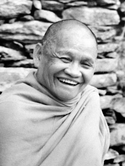
About
Ajahn Chah is a meditation teacher in the Meditation tradition.
Teaching focus
Ajahn Chah taught the same thing in a hundred different shapes. Watch the mind. Don't get involved with what you watch. Don't try to make anything happen, and don't try to push anything away. His central teaching is clear seeing of impermanence, suffering, and not-self, what the Pali tradition calls the three characteristics, but he taught them as a felt practice rather than a doctrine. He used the breath as an anchor and refused to elevate it into a special object. The point wasn't the breath, it was the watcher. He was deeply suspicious of meditative pyrotechnics. Practitioners who came back excited about jhana states or visions usually got told to keep going and stop showing off. He taught dana and sila as the actual ground of the path, not preliminary niceties, and ran his monasteries on a strict Vinaya that required Western trainees to do everything from sweeping to begging alms in Thai villages. His humor was constant and often pointed. He'd compare the mind to a poisonous snake you could safely watch from a distance and could not safely pick up. He taught that effort is necessary and also that wanting results is what blocks results. The paradox was the practice.
Background
Ajahn Chah Subhaddo (1918 to 1992) was a Thai Theravada monk and the founding teacher of one of the most influential branches of the Thai Forest tradition in the modern era. Born in Ubon Ratchathani in northeast Thailand, he ordained as a novice as a boy, disrobed, then took higher ordination as a bhikkhu in 1939. He spent years as a wandering tudong monk, walking the forests of Thailand, Laos, and Cambodia, sitting at charnel grounds, and training under various teachers including a brief but formative period with Ajahn Mun Bhuridatta, the senior teacher of the modern Thai Forest revival. In 1954 he established Wat Pah Pong in his home province, which became the seed monastery for what's now a network of more than three hundred branch monasteries across Thailand and abroad. In 1975 he founded Wat Pah Nanachat, the international forest monastery, where Western monks could train in Thai, and in 1979 he sent senior Western disciples, led by Ajahn Sumedho, to establish Cittaviveka in West Sussex, England. From there the lineage spread to Amaravati in Hertfordshire, Abhayagiri in California, Bodhinyanarama in New Zealand, and many others. Ajahn Chah's teaching style was earthy, plain, and built on direct observation of mind. He spoke in farmer's Thai, used images of water buffalo and rice fields, and avoided technical Pali jargon. He suffered a stroke in 1981 and lived for another decade unable to speak, while his lineage continued to expand. After his death in 1992 his cremation drew an estimated million people. His talks in English, gathered in books like A Still Forest Pool and Food for the Heart, remain core reading for vipassana practitioners worldwide.
Lineage
Ajahn Chah was a fully ordained bhikkhu in the Thai Forest (Kammatthana) lineage that runs from Ajahn Sao Kantasilo and Ajahn Mun Bhuridatta through the early twentieth century revival of strict Vinaya practice in northeast Thailand. He took higher ordination in 1939 and trained briefly but consequentially with Ajahn Mun. He founded Wat Pah Pong in 1954 and Wat Pah Nanachat in 1975. The Western branch monasteries he authorized, beginning with Cittaviveka in 1979, have produced senior teachers including Ajahn Sumedho, Ajahn Pasanno, Ajahn Amaro, Ajahn Sucitto, and many others.
What to expect
His talks, in transcript or audio, are short, plain, and circle the same essential instructions. The recorded archive isn't a curriculum, it's a sustained body of correction. Reading or listening, you'll meet the same advice, given again and again with different images, until something in the listener's attitude actually shifts. There's no technique to add to your collection. He'll keep returning you to the question of what wants what, and what's watching the wanting, until the question itself does something to you.