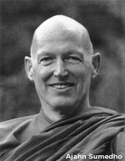
About
Ajahn Sumedho is a meditation teacher in the Meditation tradition.
Teaching focus
Sumedho's approach is unmistakable to anyone who's listened to even a handful of his talks. He doesn't teach techniques so much as a stance, a way of resting awareness that he often calls intuitive awareness or the sound of silence. In retreat settings, he asks practitioners to notice the quiet hum that's always there underneath thinking, the felt sense of awake itself, and to let attention rest there rather than chasing objects. He works with the four noble truths as a living reflection rather than a doctrine, encouraging students to investigate suffering as it shows up in any moment, including the suffering of wanting practice to be different. His instructions are deliberately simple and often repetitive. He'll come back to the same handful of phrases, this is the way it is, suffering should be understood, awareness is the refuge, sometimes for an hour, and the simplicity is the point. He talks frequently about the trap of becoming a Buddhist personality, the way ego can quietly co-opt the path itself. His later teaching has leaned increasingly toward the unconditioned, that which cannot be located in any object, and toward the recognition that awakened presence isn't something to attain but something to recognize as already present and unborn. For him, formal practice and daily life don't sit on different shelves. The same intuitive awareness that opens during a sit is what's reading these words.
Background
Ajahn Sumedho is widely regarded as the senior Western disciple of Ajahn Chah and one of the central figures in transmitting Thai Forest Buddhism to the English-speaking world. Born Robert Karr Jackman in Seattle, Washington in 1934, he served in the US Navy as a young man, taught in the Peace Corps in Borneo, and was first ordained in Thailand in 1967. He took higher ordination as a bhikkhu and went on to train under Ajahn Chah at Wat Pah Pong for roughly a decade, becoming the first Western monk to be appointed by Ajahn Chah to lead a forest monastery for foreigners, Wat Pah Nanachat. In 1977 Ajahn Chah sent him to England, and the next year he founded Cittaviveka, the Chithurst Buddhist Monastery in West Sussex. He went on to establish Amaravati Buddhist Monastery in Hertfordshire in 1984, where he served as abbot until 2010, when he stepped down and returned to Thailand, settling at Wat Ratanawan. His teaching is plain, direct, and slightly conversational, often anchored in everyday English that strips classical Theravada down to what can actually be tested in present experience. He's been the principal influence on a whole generation of Western Theravada teachers including Ajahn Amaro, Ajahn Pasanno, Ajahn Sucitto, and Ajahn Brahm. His talks circle persistently around the suffering caused by identification with the body and mind, the sound of silence as a doorway into awareness, and the value of stillness over technique. Recordings on Dharma Seed and at the Amaravati and Cittaviveka archives capture decades of his teaching, much of it given in a simple talking style with long pauses, gentle humor, and patient repetition of a few core themes.
Lineage
Sumedho is a fully ordained bhikkhu in the Thai Forest tradition of Ajahn Chah, ordained in Thailand in 1967 and trained at Wat Pah Pong for about ten years. He was the founding abbot of Wat Pah Nanachat in Thailand, the first forest monastery established specifically for non-Thai monks. In 1977 Ajahn Chah sent him to England with three other monks, and he founded Cittaviveka in West Sussex (1979) and Amaravati in Hertfordshire (1984), serving as abbot of Amaravati until 2010. He's regarded as the most senior Western monk in Ajahn Chah's lineage and the principal teacher of a generation of Western forest abbots.
What to expect
On retreat with Sumedho you'd typically encounter long sittings interspersed with walking meditation, dawn and evening Pali chanting, and dhamma talks delivered in plain English without notes. He doesn't push technique. He'll point students again and again toward simple, present awareness, the sound of silence in the background of mind, and the felt sense of being awake before any content arises. Talks tend to circle a small set of themes rather than moving forward in a curriculum. There's a strong renunciate atmosphere, since most retreats run at one of the Ajahn Chah monasteries with monastic schedules and almsround. Lay practitioners are welcomed warmly but not coddled.