About
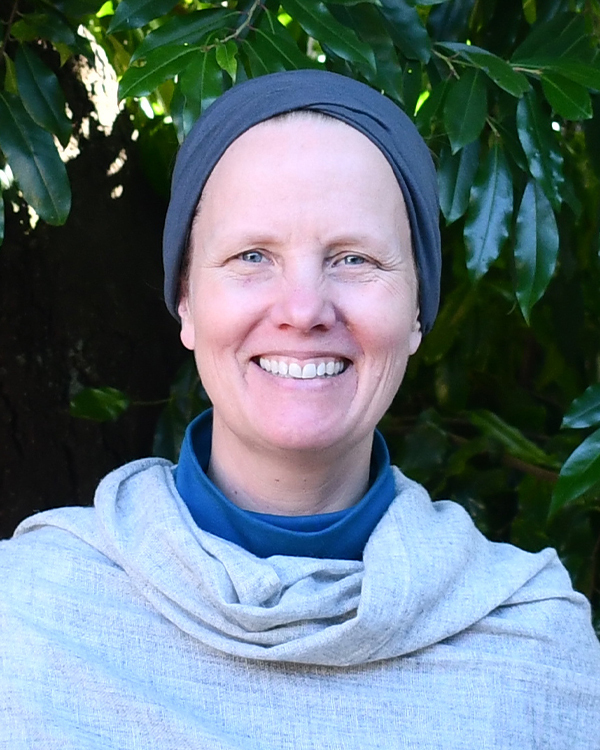
Heather Marie holds a PhD in psychology and worked in government systems addressing poverty and violence. She later turned to meditation and Dhamma practice to deepen her understanding of suffering. She is based at the Aloka Earth Room in San Rafael and is currently undertaking Lay Renunciant Training with Ayya Santacitta. Marie teaches using interpersonal dialogue and self-inquiry methods. She is affiliated with Spirit Rock.
Teaching focus
Heather Marie's teaching focus sits inside the classical Theravada tradition rooted in the Pali canon, with mindfulness of breathing and insight (vipassana) as the working ground. The classical Theravada framing means the four foundations of mindfulness, the brahmaviharas, and the gradual training are all on the table, and they're treated as a sequence that builds on itself rather than as a menu to pick from. Ethical foundation gets weight. Loving-kindness practice isn't an emotional warm-up to insight, it's a real cultivation in its own right. Across the body of work, the consistent thread in Heather Marie's teaching is the refusal to let practice become abstract. The instruction asks for direct contact with what's actually arising, and the framing supports practitioners in giving it that. Recurring questions in the teaching include how to keep practice honest across years, how to hold difficulty without bypassing it, and how the dharma actually shows up in ordinary life rather than only on the cushion. Recurring questions in the teaching include how to keep practice honest across years, how to hold difficulty without bypassing it, and how the dharma actually shows up in ordinary life rather than only on the cushion. Recurring questions in the teaching include how to keep practice honest across years, how to hold difficulty without bypassing it, and how the dharma actually shows up in ordinary life rather than only on the cushion.
Background
Heather Marie holds a PhD in psychology and worked in government systems addressing poverty and violence. She later turned to meditation and Dhamma practice to deepen her understanding of suffering. She is based at the Aloka Earth Room in San Rafael and is currently undertaking Lay Renunciant Training with Ayya Santacitta. Marie teaches using interpersonal dialogue and self-inquiry methods. She is affiliated with Spirit Rock. In this search, she discovered a love for meditation and the Dhamma. She is devoted to sharing an embodied approach using interpersonal dialogue and self inquiry. Heather resides at the Aloka Earth Room in San Rafael. She is currently working closely with people to simplify their lives. At the same time, she is undertaking a period of Lay Renunciant Training with the precious guidance of Ayya Santacitta. This opportunity affords her and others like herself a chance to deepen their spiritual practice and keep a foothold in the world. Heather Marie's teaching is anchored at Spirit Rock. The teaching draws from the classical Theravada tradition rooted in the Pali canon, with mindfulness of breathing and insight (vipassana) as the working ground. What comes through across Heather Marie's teaching is a steadiness more than a style. The framing is classical, the language is plain, and the practitioner is asked to do the work rather than be entertained. Ethical foundation isn't preliminary, it's the soil the rest grows in. Practitioners drawn to Heather Marie's teaching tend to be people who've already noticed that practice is a long arc, not a quick fix, and who want a teacher who treats it that way. Practitioners drawn to Heather Marie's teaching tend to be people who've already noticed that practice is a long arc, not a quick fix, and who want a teacher who treats it that way. Practitioners drawn to Heather Marie's teaching tend to be people who've already noticed that practice is a long arc, not a quick fix, and who want a teacher who treats it that way. Practitioners drawn to Heather Marie's teaching tend to be people who've already noticed that practice is a long arc, not a quick fix, and who want a teacher who treats it that way. Practitioners drawn to Heather Marie's teaching tend to be people who've already noticed that practice is a long arc, not a quick fix, and who want a teacher who treats it that way. Practitioners drawn to Heather Marie's teaching tend to be people who've already noticed that practice is a long arc, not a quick fix, and who want a teacher who treats it that way.
Lineage
Heather Marie teaches within the classical Theravada tradition rooted in the Pali canon. Current affiliation runs through Spirit Rock. Heather Marie teaches as a fully ordained monastic. The lineage shapes the form of the teaching, not just its content. Practitioners encountering it find a transmission line still actively developing. The lineage shapes the form of the teaching, not just its content. Practitioners encountering it find a transmission line still actively developing. The lineage shapes the form of the teaching, not just its content. Practitioners encountering it find a transmission line still actively developing. The lineage shapes the form of the teaching, not just its content. Practitioners encountering it find a transmission line still actively developing.
What to expect
In Heather Marie's classes and groups, expect guided sitting, dharma teaching held to a manageable length, and time for practitioners to ask the questions that are actually live for them. Sittings are conventional, mindfulness of breath and body, with metta and inquiry into difficult mind-states woven through. There's space for questions, and the answers don't get rushed. The atmosphere is grounded rather than performative, and practitioners tend to leave with practical ground to keep working from on their own. The atmosphere is grounded rather than performative, and practitioners tend to leave with practical ground to keep working from on their own.