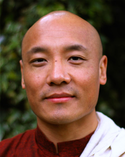
About
Jetsunma Tenzin Palmo is a Buddhist teacher affiliated with the Barre Center for Buddhist Studies. Limited biographical information is available in the provided source.
Teaching focus
Her teaching combines deep Tibetan Vajrayana practice with sustained advocacy for women's monastic ordination in Tibetan Buddhism. The work draws on her years in solitary cave retreat alongside her decades of teaching internationally. The work draws on the Tibetan Buddhist tradition as the foundational framework, taught with care for the textures of present experience rather than as abstract doctrine. Foundational shamatha and vipashyana support the more characteristic Tibetan practices: refuge and bodhicitta, deity visualization, mantra recitation, tonglen as the core compassion practice, and pointing-out instructions in the higher teachings depending on student readiness. Lovingkindness gets serious time on retreat, treated as central practice rather than supplemental, and the broader brahmavihara framework offers additional ground for the slower work of equanimity and forgiveness. Daily-life integration runs through the recorded teaching as a steady concern. The same awareness that opens during a sit is the awareness that meets traffic, family, and work, and the teaching keeps coming back to that continuity rather than treating retreat as a separate world. Across the recorded teaching runs a steady commitment to the actual work of practice, the slow unfolding that doesn't always make for inspirational soundbites but that carries the path forward across years of sitting. There's also careful work with the harder stretches of practice, the dry months, the periods when nothing seems to be moving, the recurring difficulties that don't resolve quickly. The teaching treats those stretches as honest dharma material rather than as obstacles to be pushed past.
Background
Jetsunma Tenzin Palmo is a senior teacher in the Tibetan Vajrayana tradition with roots in the Tibetan teaching lineages. Jetsunma Tenzin Palmo is a senior British-born nun in the Tibetan Buddhist tradition. She was ordained as a Tibetan Buddhist nun in the 1960s and spent twelve years living in a remote cave in the Himalayas in solitary retreat. She's the founder of Dongyu Gatsal Ling Nunnery in northern India, established to support the education and ordination of Himalayan Buddhist nuns. She's affiliated with Barre Center for Buddhist Studies for some of her Western teaching. The teacher's recorded material is mostly hosted through affiliated centers and personal platforms rather than through Dharma Seed. Senior teachers like this one often shape not only individual students but the wider ecosystem of practice around them, through retreats, mentorship, and the steady availability of recorded teaching across decades. The recordings carry a quiet warmth and an attentive specificity, the kind of teaching that rewards careful listening over time. Like many teachers in the wider Insight community, this teacher's path includes time on long silent retreat, ongoing study with senior teachers, and gradual integration of teaching responsibility through co-teaching and small local programs before stepping into broader retreat work. That apprenticeship model shapes the careful pacing of the teaching.
Lineage
Tenzin Palmo was ordained as a Tibetan Buddhist nun in the Drukpa Kagyu lineage in 1964. She spent twelve years (1976-1988) in solitary retreat in a cave in Lahaul, Himachal Pradesh. She founded Dongyu Gatsal Ling Nunnery in 1999 in Himachal Pradesh, India. The teacher holds full monastic ordination and teaches from inside that renunciate framing. She founded Dongyu Gatsal Ling Nunnery in India and is affiliated with Barre Center for Buddhist Studies for some of her Western teaching.
What to expect
International teaching programs and visits to Dongyu Gatsal Ling Nunnery in India. Her teaching is in English alongside her Tibetan-language work for the nunnery community. Programs include traditional Tibetan elements alongside formal sitting: refuge and bodhicitta practice, mantra recitation, visualization, and tonglen, with shrine forms and offerings that distinguish Vajrayana retreats from their Theravada counterparts. The tone is unhurried and grounded, with attention given to the practical questions students bring rather than to large theoretical frameworks. For practitioners working at distance, recorded talks and online programs often offer a good initial point of contact, with in-person retreat following once the teaching voice and approach have become familiar.