About
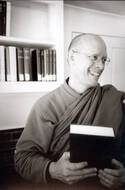
Santikaro is a Theravada bhikkhu ordained in 1985 who lived with Ajahn Buddhadasa for nine years and served as his primary translator. He spent most of his monastic life at Suan Mokkh in Thailand, where he led Dawn Kiam, a monastic community for Western practitioners. He founded Liberation Park, a Buddhist practice center in southwestern Wisconsin. Santikaro teaches Buddhism and meditation with emphasis on early Pali texts and has translated works of Buddhadasa.
Teaching focus
Santikaro teaches in a theravada register, and the recorded talks point back, again and again, to a small set of practices done carefully. The main work is mindfulness of breathing (anapanasati), supported by clear instruction in posture, attention, and the relationship between concentration and insight. Pali source texts get cited often, not as scholarship for its own sake, but as a way of grounding modern instruction in what the early teachings actually say. The voice across Santikaro's talks is conversational rather than lecture-style. Sentences land with care, pauses are real pauses, and there's space left for the listener's own attention to do the work. There's a recurring trust that practice isn't about adding more to an already busy life. It's about subtracting noise until what's already there can be felt clearly. Santikaro's framing rewards re-listening: the same instructions land differently as practice matures, which is usually a sign of a teacher worth staying with. Santikaro's framing rewards re-listening: the same instructions land differently as practice matures, which is usually a sign of a teacher worth staying with. Santikaro's framing rewards re-listening: the same instructions land differently as practice matures, which is usually a sign of a teacher worth staying with. Santikaro's framing rewards re-listening: the same instructions land differently as practice matures, which is usually a sign of a teacher worth staying with.
Background
Santikaro is a Theravada bhikkhu ordained in 1985 who lived with Ajahn Buddhadasa for nine years and served as his primary translator. He spent most of his monastic life at Suan Mokkh in Thailand, where he led Dawn Kiam, a monastic community for Western practitioners. He founded Liberation Park, a Buddhist practice center in southwestern Wisconsin. Santikaro teaches Buddhism and meditation with emphasis on early Pali texts and has translated works of Buddhadasa. Santikaro teaches in the Insight Meditation lineage that came West in the 1970s through teachers trained in Burma and Thailand. The Western insight movement, anchored at IMS in Massachusetts and Spirit Rock in California, has been the main on-ramp for English-speaking lay practitioners since then. For listeners trying to find a steady teacher voice rather than a single great talk, Santikaro's recorded archive is the kind of place you can spend months and not run out of useful material. The talks tend to repay re-listening, especially as practice deepens and the same words land differently. As with any teacher in this lineage, the most useful next step is usually to listen to a handful of Santikaro's recorded talks back to back, notice which language and framings actually open the practice for you, and then sit with what's there rather than collecting more material. Reading and listening can substitute for practice for a while, but eventually the only useful thing is to put the headphones down and sit. As with any teacher in this lineage, the most useful next step is usually to listen to a handful of Santikaro's recorded talks back to back, notice which language and framings actually open the practice for you, and then sit with what's there rather than collecting more material. Reading and listening can substitute for practice for a while, but eventually the only useful thing is to put the headphones down and sit. As with any teacher in this lineage, the most useful next step is usually to listen to a handful of Santikaro's recorded talks back to back, notice which language and framings actually open the practice for you, and then sit with what's there rather than collecting more material. Reading and listening can substitute for practice for a while, but eventually the only useful thing is to put the headphones down and sit. As with any teacher in this lineage, the most useful next step is usually to listen to a handful of Santikaro's recorded talks back to back, notice which language and framings actually open the practice for you, and then sit with what's there rather than collecting more material. Reading and listening can substitute for practice for a while, but eventually the only useful thing is to put the headphones down and sit.
Lineage
Santikaro teaches in robes within the theravada tradition. Affiliated with Insight Meditation Center, Insight Retreat Center. Training links published in the source bio include Ajahn Buddhadasa. For specifics on ordination, root teachers, or current sangha affiliations, the teacher's own website and recorded talks are the most reliable source. Santikaro's teaching reaches lay practitioners primarily through recorded talks and retreat invitations, which is how most English-speaking students of this lineage encounter the work. Santikaro's teaching reaches lay practitioners primarily through recorded talks and retreat invitations, which is how most English-speaking students of this lineage encounter the work. Santikaro's teaching reaches lay practitioners primarily through recorded talks and retreat invitations, which is how most English-speaking students of this lineage encounter the work.
What to expect
On a retreat or sit with Santikaro, expect long stretches of silent practice anchored in mindfulness of breathing (anapanasati), walking meditation done at an honest pace, and dharma talks that build slowly across days rather than packing everything into one session. Retreats are generally residential and silent, with a daily schedule that alternates sitting and walking from early morning into evening. Q&A or interviews with the teacher are usually built in. Online sessions, where they're available, follow a similar shape scaled down: a guided sit, a talk, and time for questions. Expect quiet. Expect to be left alone with your own practice for stretches that feel longer than what most lay-life schedules allow. That's part of how the form works.