About
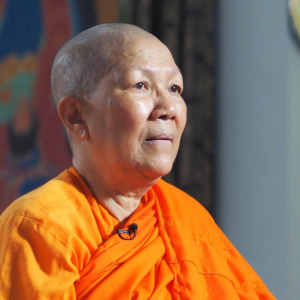
Venerable Dhammananda is a Theravada bhikkhuni (female monastic) ordained in Sri Lanka in 2001. She was the first woman to receive full ordination in the Theravada tradition in Thailand. Formerly known as Dr. Chatsumarn Kabilsingh, she held a PhD in Buddhism from Magadh University and taught at Thammasat University in Bangkok for 27 years. She has authored over 100 books and translated 27 works on Tibetan Buddhism, including the first Thai translation of the Lotus Sutra. She serves as abbess of Songdhammakalyani Temple, an all-female monastery near Bangkok founded by her mother. Her work focuses on re-establishing the Theravada female monastic lineage in Asia and educating women in Buddhist practice.
Teaching focus
Venerable Dhammananda's teaching focus, drawn from the source profile, sits in the Theravada tradition. Several threads come up: dharma applied to social and collective suffering;. On talks, the style is closer to thinking-along than presenting. Venerable Dhammananda works with whatever shows up in the room rather than reading from notes, which is part of why these talks land as conversational instead of scripted. Short pauses, longer sits, and questions that come back to direct experience are usual. Listed specialties on the source profile include advanced practice. The bigger move Venerable Dhammananda keeps making is back toward attention itself: what's happening, how it's being held, and what gets in the way. That keeps the teaching close to practice rather than drifting into commentary about practice. For talks, schedules, and longer essays, the affiliated organization's page is where the live material lives. Venerable Dhammananda's sessions tend to keep returning to the body, to breath, and to the felt quality of attention as the steady ground that the rest rests on. Venerable Dhammananda's sessions tend to keep returning to the body, to breath, and to the felt quality of attention as the steady ground that the rest rests on. Venerable Dhammananda's sessions tend to keep returning to the body, to breath, and to the felt quality of attention as the steady ground that the rest rests on.
Background
Venerable Dhammananda teaches in the Theravada tradition. The teaching home is InsightLA. From the teacher's own profile: Venerable Dhammananda changed the landscape of her native Thailand by becoming the first woman to receive full ordination in the Theravada Buddhist tradition as a bhikkhuni (female monastic). Ordained in Sri Lanka in 2001, she faced enormous ridicule and opposition when she returned home. In 2019 the BBC named her to its list of 100 of the most influential women in the world because of her tireless work to re-establish the Theravada female monastic lineage in Asia. In November of 2014 she was appointed the first Thai Pavattini (bhikkhuni teacher) by Most Venerable Mahindavamsa Maha Nayaka of the Ampura sect in Sri Lanka. In 2004 she received the UN Outstanding Buddhist Woman award, and in 2005 she was one of one thousand “Peace Women” to be nominated for a Nobel Peace Prize. She is a wise Buddhist scholar, and a social and environmentalist activist. Formerly known by her lay name, Dr. Chatsumarn Kabilsingh, received her BA in Philosophy from Visva Bharati University located in West Bengal, India, her master’s degree in Religious Studies from McMaster University in Ontario, Canada, and her PhD in Buddhism from Magadh University in Bodh Gaya, India. She was a professor of Buddhism and Eastern Philosophy at Thammasat University in Bangkok for twenty-seven years. She has authored more than 100 books including several written in English. Her most popular book in English is Thai Women in Buddhism published by Parallax Press in 1991. She has translated 27 books on Tibetan Buddhism including Freedom in Exile, H.H. the Dalai Lama. Among her most important works is the first Thai translation of the Lotus Sutra. As Abbess of Songdhammakalyani Temple, an all-female monastery founded by her mother more than sixty years ago, she devotes her life to educating and training women. The temple is located about 60 kilometers west of Bangkok in the city of Nakon Pathom. In the Insight stream Venerable Dhammananda works inside, the emphasis is on direct attention to body, feeling tone, and mind, alongside the brahmaviharas and an ongoing investigation of how clinging and aversion arise. Talks tend to be conversational rather than scripted, and there's room for sila and ethics to be talked about as part of practice rather than as a separate topic. Venerable Dhammananda's page on OMP collects the publicly available bio, the listed affiliations, and any talks tracked through the source archive, and is meant as a directory entry rather than an authorized biography.
Lineage
Venerable Dhammananda teaches as a monastic teacher in the Theravada tradition. The institutional home, per the source listing, is InsightLA, and that's where most of the public teaching schedule and any retreat offerings will be posted. The Insight lineage in the West runs through teachers like Mahasi Sayadaw, U Ba Khin, Anagarika Munindra, and Dipa Ma into the founders of IMS, Spirit Rock, and the regional centers, and most contemporary Insight teachers position themselves somewhere in that broad family.
What to expect
On a class or retreat with Venerable Dhammananda, the basic shape is short instruction, longer sittings, and some Q&A. The container is shaped by InsightLA, so format details, fees, and access policies follow that organization's norms. Expect plenty of silence, less talking-at-you than you might think, and an emphasis on letting the practice do its work rather than chasing experiences. For exact dates, registration, and any sliding-scale or scholarship information, There's usually a short Q&A window and, on retreats, optional teacher interviews where students can bring specific questions about their practice. There's usually a short Q&A window and, on retreats, optional teacher interviews where students can bring specific questions about their practice.