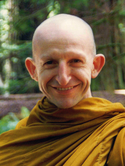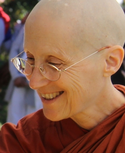
About
Ayya Medhanandi is a Theravada Buddhist nun ordained in the Burmese tradition under Sayādaw U Pandita Mahāthera at the Yangon Mahasi retreat centre in 1988. She trained in the Ajahn Chah Thai Forest Saṅgha at Amaravati in the UK for ten years before pursuing a more solitary practice. She received bhikkhunī ordination at Ling Quan Chan Monastery in Taiwan in 2007. In 2008, she established Sati Sārāṇīya Hermitage in Canada at the invitation of the Ottawa Buddhist Society and Toronto Theravāda Buddhist Community.
Teaching focus
Ayya Medhanandi's teaching focus sits inside the classical Theravada tradition rooted in the Pali canon, with mindfulness of breathing and insight (vipassana) as the working ground. The classical Theravada framing means the four foundations of mindfulness, the brahmaviharas, and the gradual training are all on the table, and they're treated as a sequence that builds on itself rather than as a menu to pick from. Ethical foundation gets weight. Loving-kindness practice isn't an emotional warm-up to insight, it's a real cultivation in its own right. For practitioners with substantial prior experience, the teaching doesn't slow itself down or restate foundations that are already in place. The teaching is shaped by the silent-retreat container, with the long arcs and the sustained quiet that container makes possible. Across the body of work, the consistent thread in Ayya Medhanandi's teaching is the refusal to let practice become abstract. The instruction asks for direct contact with what's actually arising, and the framing supports practitioners in giving it that. Recurring questions in the teaching include how to keep practice honest across years, how to hold difficulty without bypassing it, and how the dharma actually shows up in ordinary life rather than only on the cushion.
Background
Ayya Medhanandi is a Theravada Buddhist nun ordained in the Burmese tradition under Sayādaw U Pandita Mahāthera at the Yangon Mahasi retreat centre in 1988. She trained in the Ajahn Chah Thai Forest Saṅgha at Amaravati in the UK for ten years before pursuing a more solitary practice. She received bhikkhunī ordination at Ling Quan Chan Monastery in Taiwan in 2007. In 2008, she established Sati Sārāṇīya Hermitage in Canada at the invitation of the Ottawa Buddhist Society and Toronto Theravāda Buddhist Community. Thus began her monastic training in the Burmese tradition. When the borders were closed to foreigners by a military coup, in 1990 Sayādaw blessed her to join the Ajahn Chah Thai Forest Saņgha at Amaravati, UK. After ten years in their siladhāra community, Ayyā felt called to more seclusion and solitude in New Zealand and SE Asia. In 2007, having waited nearly 20 years, she received bhikkhunī ordination at Ling Quan Chan Monastery in Keelung, Taiwan and returned to her native Canada in 2008, on invitation from the Ottawa Buddhist Society and Toronto Theravāda Buddhist Community, to establish Sati Sārāņīya Hermitage. The teaching draws from the classical Theravada tradition rooted in the Pali canon, with mindfulness of breathing and insight (vipassana) as the working ground. Areas of particular focus include silent retreat, advanced practice. The recorded talk archive on Dharma Seed currently runs to roughly 364 recordings, which gives a long view of how the teaching has developed across years. Retreat teaching is part of the ongoing schedule, with 27 retreats logged through the public archives so far. What comes through across Ayya Medhanandi's teaching is a steadiness more than a style. The framing is classical, the language is plain, and the practitioner is asked to do the work rather than be entertained. Ethical foundation isn't preliminary, it's the soil the rest grows in. Practitioners drawn to Ayya Medhanandi's teaching tend to be people who've already noticed that practice is a long arc, not a quick fix, and who want a teacher who treats it that way. Practitioners drawn to Ayya Medhanandi's teaching tend to be people who've already noticed that practice is a long arc, not a quick fix, and who want a teacher who treats it that way. Practitioners drawn to Ayya Medhanandi's teaching tend to be people who've already noticed that practice is a long arc, not a quick fix, and who want a teacher who treats it that way.
Lineage
Ayya Medhanandi teaches within the classical Theravada tradition rooted in the Pali canon. In 1988, at the Yangon Mahasi retreat centre in Burma, Ayyā requested ordination as a bhikkhunī from her teacher, the Venerable Sayādaw U Pandita Mahāthera. Ayya Medhanandi teaches as a fully ordained monastic. The lineage shapes the form of the teaching, not just its content. Practitioners encountering it find a transmission line still actively developing. The lineage shapes the form of the teaching, not just its content. Practitioners encountering it find a transmission line still actively developing. The lineage shapes the form of the teaching, not just its content. Practitioners encountering it find a transmission line still actively developing.
What to expect
On retreat with Ayya Medhanandi you'll get long sits, walking practice, and dharma talks that build on each other across days. The container is silent or near-silent, which gives the teaching room to land in a way that single classes can't quite reach. Sittings are conventional, mindfulness of breath and body, with metta and inquiry into difficult mind-states woven through. There's space for questions, and the answers don't get rushed. The atmosphere is grounded rather than performative, and practitioners tend to leave with practical ground to keep working from on their own. The atmosphere is grounded rather than performative, and practitioners tend to leave with practical ground to keep working from on their own.