About
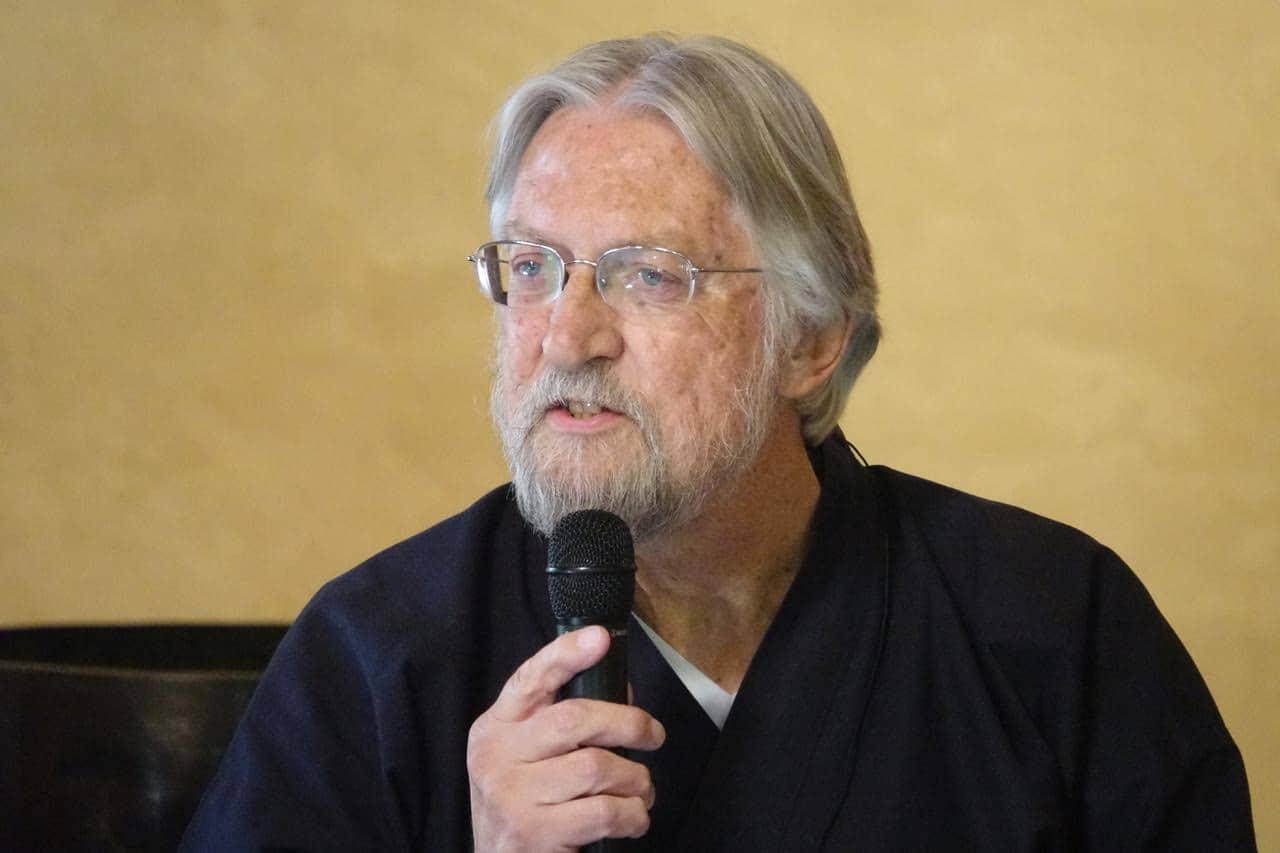
Ian Boyden is a visual artist, writer, and translator affiliated with Upaya Zen Center. He studied Chinese paleography, poetry, painting, and calligraphy in China, with degrees in art history from Wesleyan University and Yale University. His work examines relationships between mind and environment, often linking visual art with ecological awareness. He has translated poetry by Tibetan writer Tsering Woeser and curated exhibitions of contemporary art, including work by Ai Weiwei. His book A Forest of Names: 108 Meditations was published by Wesleyan University Press in 2020.
Teaching focus
Boyden's teaching at Upaya sits inside the center's Soto Zen container. The basic form is zazen, just sitting, with the posture and breath held lightly and the mind allowed to settle without force. Around that core, Upaya's programs build out a wider arc that includes the Bodhisattva precepts, oryoki meal practice, walking meditation (kinhin), dharma talks, and the GRACE framework Roshi Joan developed for clinicians working at the bedside. Boyden teaches inside that framework, which means the work isn't just on the cushion. Students are asked to bring practice into the spaces where it actually gets tested: at the bedside, in conversation, in moments of grief or political reactivity, in the long, slow work of climate and justice. Upaya's approach is recognizable for its refusal to keep zazen and the world in separate boxes. The cushion and the clinic, the cushion and the kitchen, the cushion and the protest line are all treated as the same field of practice, not different ones. Boyden's contribution stays in that key. Teaching sessions emphasize uprightness, attention, and the Bodhisattva vow as something lived in specific situations rather than recited as an idea. There's room for silence. There's also room for hard conversations about what practice asks of a person in a world under pressure.
Background
Ian Boyden appears in Upaya Zen Center's teacher and faculty roster as part of the wider contemplative community Roshi Joan Halifax has gathered in Santa Fe, New Mexico, over the past four decades. The biographical material on file is drawn directly from Upaya's own teacher page and reflects what Boyden has chosen to share there. Ian Boyden is a visual artist, writer, translator, and curator. Consistent across his work is an abiding interest in how the mind blossoms in relationship to the environment. He lived for many years in China, studying Chinese paleography, poetry, painting, and calligraphy, especially the way language and the arts were shaped by Buddhist philosophy. Ultimately, he received degrees in the History of Art from Wesleyan University (Middletown, CT) and Yale University. Boyden’s visual art often links the literary, material, and visual imaginations, paying keen attention to how his work can shape ecological awareness. Boyden makes his own paints and inks from unusual materials such as meteorites, shark teeth, freshwater pearls, and carbon sourced from the aftermath of forest fires. He selects materials to establish a direct link between them and the subjects of his paintings, establishing a new form of material translation. His work has been exhibited widely, including a solo exhibition at the I.M. Pei designed Suzhou Museum. His books and paintings are found in many public collections including Reed College, Stanford University, the Portland Art Museum, and the Victoria & Albert Museum. As a writer, translator, and curator, Boyden focuses on the environment, human rights and ways artists respond to authoritarian governments. In recent years, he has worked with two Chinese dissident writers and artists, Tsering Woeser and Ai Weiwei. In 2016, Boyden curated the exhibition Ai Weiwei: Fault Line, which led to his book of poems A Forest of Names: 108 Meditations, published by Wesleyan University Press (2020). His translations of Woeser’s poems have appeared on several human rights and Tibetan cultural websites, including Radio Free Asia, Invisible Tibet, and High Peaks Pure Earth. Boyden was awarded a 2019 NEA Literature Translation Fellowship to translate a manuscript of Woeser’s poetry. He has authored and co-authored several books and essays including The Tables of Jupiter: Graphic Work by Timothy C. Ely (2004), Reflections on Forgotten Surfaces: The Calligraphy of Hua Rende (2005), and Roots of Clouds, Transcendence of Stones (2006). In his spare time, he loves to translate early Chan poems and koans. He currently lives on the Oregon coast. That body of work places Boyden inside a center known for blending Soto Zen practice with contemplative care for the dying, climate work, neuroscience dialogues, and a long-running program for clinicians and chaplains called GRACE. Upaya's roster mixes resident priests with visiting scholars, doctors, scientists, poets, and indigenous knowledge holders, and the programs reflect that blend. Boyden's appearances at Upaya situate this work inside that wider conversation between zazen and the world it sits inside. For practitioners who arrive at Upaya through a sesshin or a Being with Dying training, the common thread is a posture of upright, alert presence under whatever conditions show up. The forms are recognizably Soto Zen: zazen, kinhin, oryoki, the Bodhisattva precepts, dharma talks, and dokusan with senior teachers. The framing is wider than any single discipline, which is part of what has made Upaya a meeting ground for working clinicians, scientists, artists, and long-time Buddhist practitioners. Boyden contributes to that container in the role Upaya's website assigns. People interested in the specific arc of Boyden's career outside Upaya can follow the linked website and external publications listed on the Upaya page itself, which is where any deeper biographical detail belongs.
Lineage
Boyden's teaching home for the work documented here is Upaya Zen Center in Santa Fe, founded by Roshi Joan Halifax in the 1980s and rooted in the Soto Zen lineage. Upaya's broader faculty includes resident priests, visiting senior teachers, scientists, clinicians, poets, and indigenous knowledge holders. Boyden contributes as part of Upaya's wider faculty rather than as a Zen priest. Information about specific dharma transmission lines, ordination, or external lineage roots belongs on Boyden's own site rather than fabricated here.
What to expect
In a program with Boyden at Upaya, expect zazen and Soto Zen forms held alongside teaching focused on contemplative care for the dying, grief, and serious illness. Many of these programs draw on Upaya's Being with Dying curriculum and the GRACE framework Roshi Joan developed for clinicians. There's room for personal experience and difficult emotion, held inside the container of practice rather than processed away. The schedule is recognizable as Zen: sittings, walking, meals, talks, and time for questions. Quiet is taken seriously. Most participants leave with both a steadier practice and a more honest relationship with mortality.